Digital guide
You are here:
- Home
- Kollmorgen
- Kollmorgen AKM22E-ANBNR-0
Kollmorgen AKM22E-ANBNR-0
Product Overview:
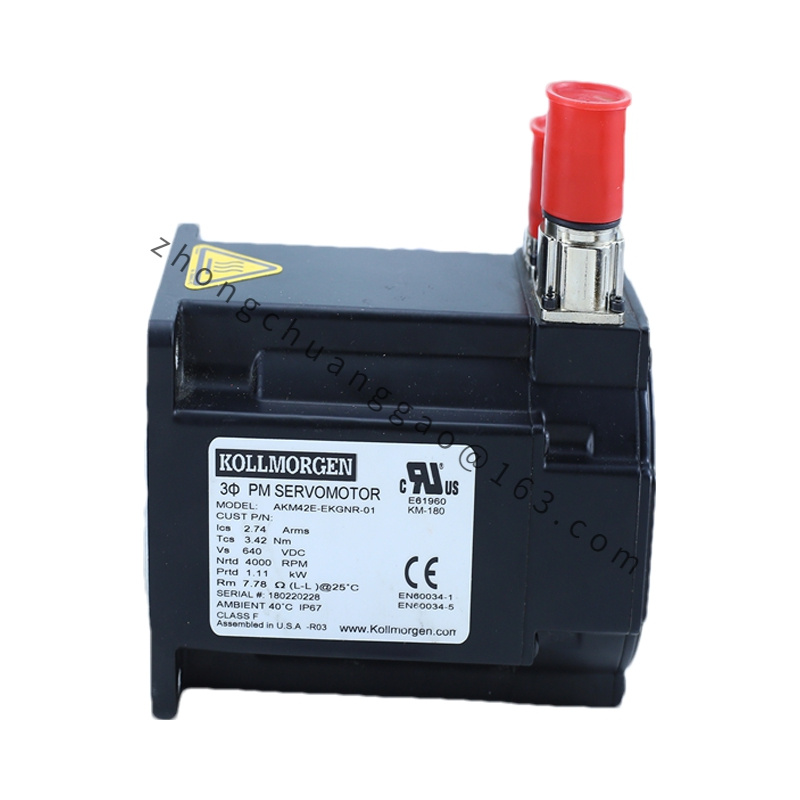
The AKM22E-ANBNR-0 is a frameless brushless servo motor from the AKM22E product family by Kollmorgen. Frameless motors consist of only the stator and rotor assemblies with no housing, bearings, or shaft — they are designed to be integrated directly into the customer’s mechanical structure. The model code breaks down as: AKM (Kollmorgen servo motor), 22 (22 mm outer diameter stator), E (Electrical length variant), A (Winding variant), N (Natural convection cooling), B (Standard magnet grade), N (Incremental encoder), R (Radial shaft/bore configuration), 0 (Revision level).
Detailed content
Technical Specifications:
| Parameter | Value |
|---|---|
| Stator Outer Diameter | 22 mm (0.866 in) |
| Stator Inner Diameter (Bore) | 8 mm (0.315 in) |
| Stator Length | 18 mm (0.709 in) |
| Rotor Outer Diameter | 20 mm (0.787 in) |
| Rotor Length | 16 mm (0.630 in) |
| Continuous Torque | 0.17 Nm (24 oz-in) |
| Peak Torque | 0.51 Nm (72 oz-in) |
| Continuous Speed (at rated torque) | 3,000 RPM |
| Maximum Speed | 8,000 RPM |
| Torque Constant (Kt) | 0.054 Nm/A |
| Back-EMF Constant (Ke) | 0.51 V/krpm |
| Terminal Resistance (R) | 3.6 Ω (phase-to-phase, 25°C) |
| Terminal Inductance (L) | 0.45 mH (phase-to-phase) |
| Rotor Inertia | 0.06 g·cm² (0.6 × 10⁻⁶ kg·m²) |
| Weight (stator + rotor) | 28 g (0.062 lb) |
| Encoder Type | Incremental (A/B/Z), 500 lines/rev (2000 counts/rev in quadrature) |
| Encoder Voltage | 5 V DC (TTL compatible) |
| Insulation Class | Class H (180°C) |
| Operating Temperature | -20°C to +100°C (winding) |
| Cooling Method | Natural convection (N) |
| Magnet Grade | Standard NdFeB (B) |
Functional Features:
- Hollow bore design allows direct mounting onto customer shaft or with custom hub
- High torque-to-inertia ratio enabling rapid acceleration
- Incremental encoder with 500 lines/rev for precise position feedback
- Low cogging torque design for smooth low-speed operation
- Class H insulation for high-temperature environments
- Pre-balanced rotor for high-speed operation up to 8,000 RPM
Structural Characteristics:
- Stator: Laminated silicon steel core with copper windings, potted with epoxy resin for thermal conductivity and vibration damping
- Rotor: NdFeB (Neodymium-Iron-Boron) permanent magnets bonded to high-strength carbon steel sleeve
- Bearings: Not included — customer must provide bearings compatible with 8 mm bore
- Shaft: Not included — frameless design integrates into customer mechanism
- Encoder: Optical incremental encoder mounted on stator rear with flexible cable exit
Working Principle:
The AKM22E-ANBNR-0 operates as a three-phase brushless DC motor. The drive supplies three-phase AC current to the stator windings in sequence, creating a rotating magnetic field. The permanent magnets on the rotor follow this field, producing continuous rotation. The incremental encoder generates A, B, and Z pulse trains proportional to rotor position, which the servo drive uses for closed-loop position/velocity control. The hollow bore allows the motor to be mounted as a direct-drive element with the customer’s load attached to the rotor.
Advantages:
- Zero backlash, zero coupling losses when integrated as direct-drive
- Extremely compact — 22 mm OD fits in space-constrained applications
- High torque density — 0.17 Nm continuous in a 28 gram package
- Custom mechanical integration — no housing constraints from motor manufacturer
- Wide speed range — 0 to 8,000 RPM
Applicable Industries:
- Robotic joint actuators
- Gimbal and stabilization systems
- Medical robotic arms (surgical robots)
- Aerospace actuation mechanisms
- Optical scanning and pointing systems
- Semiconductor wafer handling
- Exoskeleton and prosthetic devices
Installation Requirements:
- Press-fit stator into customer housing with interference fit of 0.02–0.05 mm
- Rotor must be balanced as an assembly with customer load (balance grade G2.5 / ISO 1940)
- Bearings must support 8 mm bore — recommended angular contact ball bearings (e.g., 688ZZ or equivalent)
- Encoder cable must be routed away from high-current power cables (minimum 50 mm separation)
- Thermal path from stator to customer structure must be ensured for continuous operation
Usage Precautions:
- Do not exceed 8,000 RPM — rotor disintegration risk above rated speed
- Do not apply axial loads directly to rotor — use thrust bearing at rear
- Encoder cable must not be bent below 15 mm radius at exit point
- Operate within -20°C to +100°C winding temperature range
- Demagnetization risk exists above 150°C — monitor thermal conditions
- Do not disassemble — stator windings are potted and non-serviceable

.jpg)