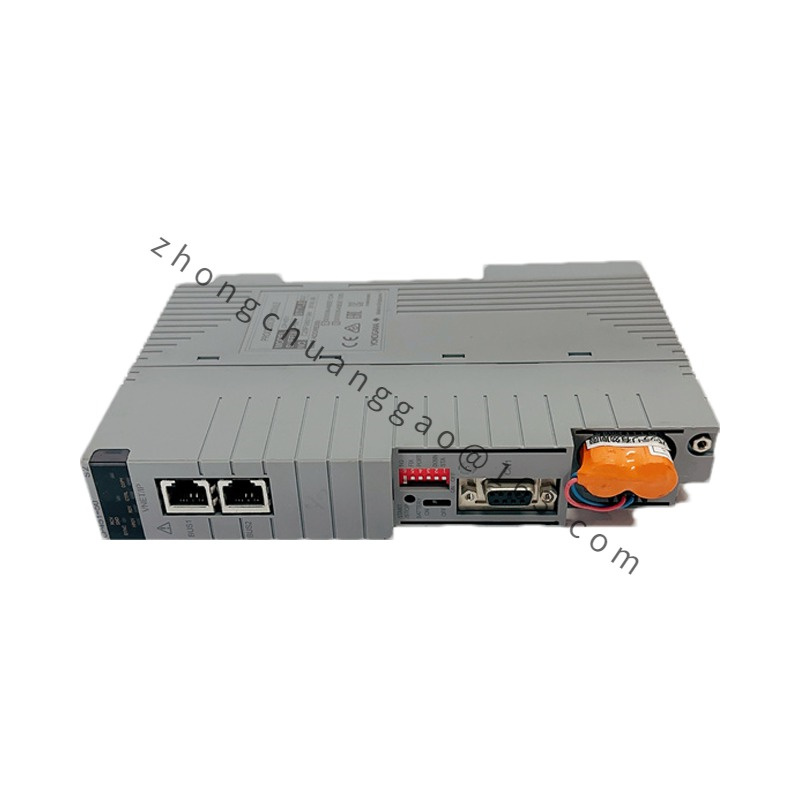
Yokogawa UT55A-010-11-00 Advanced Digital Indicating Temperature Controller
Yokogawa UT55A-010-11-00 Advanced Digital Indicating Temperature Controller
echnical Specifications:
Input Type: Universal input supporting thermocouple (K/J/T/B/R/S/E/N), RTD (Pt100/JPt100/Cu100), 0-10V DC voltage, 0-20mA DC current, and 0-100mV DC millivolt signals.
Indication Accuracy: ±0.1% of full scale, ensuring precise measurement results.
Control Cycle: 50ms/100ms/200ms, adjustable to meet different control response requirements.
Control Output: Relay contact, voltage pulse, current output (4-20mA DC) are available.
Communication Interface: Standard Ethernet (Modbus/TCP), RS – 485 (Modbus/RTU, P2P), optional PROFIBUS – DP.
Working Voltage: 100-240V AC, 50/60Hz; power consumption is 10VA.
Working Temperature: -10℃ to 55℃, storage temperature: -20℃ to 60℃.
It is equipped with a 14 – segment 5 – digit color LCD display with a bar graph, which can clearly display process values (PV), set values (SP), and other key data, and the screen color can be changed according to the status.
It has 8 control algorithms, such as ON/OFF, PID (continuous/time – proportional), heating/cooling, and position proportional control, to meet various control needs.
The standard ladder diagram sequence control function can replace a small – size PLC to realize simple logic control, and the programming can be completed through LL50A software.
It has rich alarm functions, including PV high/low alarm, deviation alarm, rate – of – change alarm, heater burnout alarm, etc., to ensure the safety of the production process.
It supports feedforward control and cascade control, which can effectively compensate for interference variables and improve control accuracy.
Application Scenarios: It is widely used in the heat treatment industry for controlling the temperature of heating furnaces and quenching equipment to ensure the stability of material properties; in the chemical industry for monitoring and controlling the temperature and pressure of reaction kettles to prevent over – limit operation; in the food processing industry for adjusting the temperature of sterilization kettles and baking equipment to ensure food safety and quality; in the semiconductor manufacturing industry for accurately controlling the temperature of etching and deposition processes to improve product yield.