Digital guide
You are here:
- Home
- Kollmorgen
- Kollmorgen AKM22E-ANCNR-00
Kollmorgen AKM22E-ANCNR-00
Product Brief
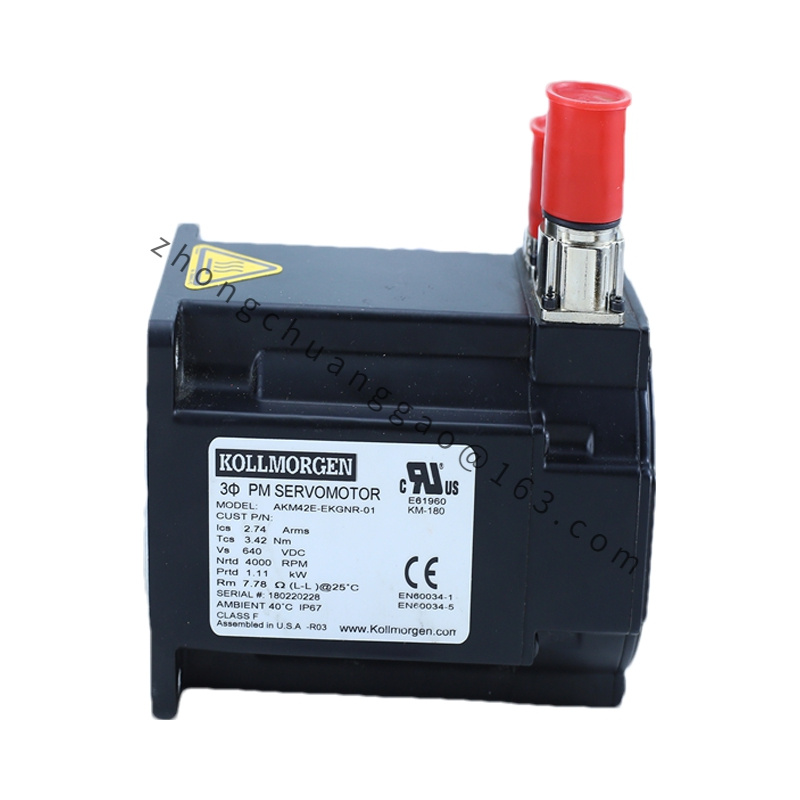
Small-frame low-inertia high-speed AC permanent magnet synchronous servo motor matching global 480VAC high-voltage industrial power grids; ANCNR suffix integrates high-resolution Sine/Cos analog encoder and 24VDC spring-applied holding brake, compatible with all AKD-P high-voltage servo drives for ultra-smooth low-speed precision motion control.
Detailed content
Technical & Performance Specifications
- Stator Winding Rated Voltage: 480 VAC three-phase high-voltage industrial power grid matching
- Continuous Rated Stall Torque: 1.8 Nm
- Peak Overload Torque: 5.4 Nm (300% short-time overload capacity, max 8s continuous overload)
- Max Rated Continuous Rotational Speed: 8000 RPM
- Frame Size: AKM22 small compact frame, square front flange dimension 70 mm
- Suffix ANCNR Hardware Definition:
A = Standard 480VAC high-voltage stator winding
N = Single cable power + encoder combined connector
CN = High-resolution Sine/Cos analog incremental rotary encoder
R = 24VDC spring-applied electromagnetic holding brake
- Shaft & Seal Configuration: Smooth solid output shaft, double-lip fluorine rubber IP65 shaft sealing ring
- Insulation Class: Class F (Max winding operating temperature 155°C)
- Environmental Protection Rating: Motor main housing IP65, front shaft output end IP67
- Shaft Static Axial Allowable Load: 180 N continuous static load
- Shaft Static Radial Allowable Load: 260 N continuous static load
- Operating Ambient Temperature Range: -5°C ~ +40°C full rated torque output; 6% torque derate per 1000 m altitude above sea level
- Storage Temperature Range: -40°C ~ +85°C
Functional Features
- Low-inertia NdFeB rare-earth permanent magnet rotor delivers ultra-fast acceleration and deceleration dynamic response for short-cycle high-speed positioning equipment
- High-resolution Sine/Cos analog encoder achieves thousands of internal signal subdivisions to eliminate low-speed torque ripple and vibration
- R suffix integrated 24VDC spring-applied holding brake locks motor shaft upon brake power de-energized for zero-backlash static load positioning
- Double-lip fluorine rubber shaft sealing ring blocks workshop dust, coolant mist and light liquid splashing to protect internal bearing assembly
- Class F high-temperature insulation supports sustained full-load high-speed operation without winding thermal degradation
- Single combined power + encoder cable connector reduces wiring complexity and cabinet cable space occupation
- Optimized low cogging electromagnetic design ensures ultra-smooth vibration-free rotation at sub-10 RPM ultra-low operating speeds
Material Composition
- Motor Housing: Thin die-cast aluminum alloy with radial cooling fin structure, black hard anodic anti-corrosion coating
- Rotor Assembly: Stacked silicon steel core embedded with sintered NdFeB rare-earth permanent magnet rings
- Stator Winding: Class F high-temperature enameled copper wire with vacuum epoxy impregnation insulation treatment
- Output Shaft: 4340 quenched and tempered alloy steel shaft with surface wear hardening polishing treatment
- Bearing Set: Double sealed light-duty angular contact ball bearings filled with high-temperature synthetic grease
- Feedback Unit: Hermetically sealed metal alloy Sine/Cos analog encoder housing mounted on motor rear end cap
- Brake Assembly: Cast aluminum alloy brake shell, wear-resistant metal friction disc, copper electromagnetic coil spring compression structure
Structural Characteristics
- Compact 70 mm square front flange mounting layout with four symmetrical fixing bolt holes for miniature automation fixture installation
- Full radial external cooling fin housing for passive natural convection heat dissipation during continuous high-speed operation
- Rear end cap fully enclosed encoder and brake compartment isolated from motor main cavity to prevent metal chip and dust contamination
- Single combined quick-disconnect connector on motor side wall integrating three-phase power output and analog encoder feedback signal pins
- Front double-lip fluorine rubber shaft sealing ring installed at shaft output end to upgrade environmental protection performance
- Standard smooth solid output shaft compatible with clamp-type elastic couplings and timing belt pulleys
Working Principle
- AKD-P series 480VAC high-voltage servo drive outputs three-phase sinusoidal variable-frequency AC current to motor stator winding coils
- Rotating electromagnetic field generated by stator windings interacts with rotor embedded NdFeB permanent magnet ring to produce continuous high-dynamic rotational torque output
- Rear-mounted high-resolution Sine/Cos analog encoder outputs orthogonal sine and cosine analog voltage signals corresponding to real-time rotor angular position, transmits feedback data back to matched AKD servo drive
- Servo drive subdivides analog sine/cosine signals to achieve ultra-high positioning resolution, executes triple closed-loop torque/velocity/position control algorithms for vibration-free precision motion
- When 24VDC brake release power supply is disconnected, built-in compression spring pushes brake friction disc to lock output shaft; energized brake coil pulls friction disc away to release free motor rotation
Advantage Highlights
- Ultra-low rotor inertia supports 8000 RPM maximum high-speed operation for short-cycle rapid positioning automation equipment
- Sine/Cos analog encoder enables ultra-fine signal subdivision to eliminate low-speed torque ripple, ideal for optical and semiconductor precision positioning applications
- Integrated spring holding brake maintains static positioning accuracy without continuous power draw, cutting standby energy consumption
- IP65 full housing + IP67 front shaft sealing adapts to light coolant mist and dusty workshop production environments
- Single combined power/encoder cable connector reduces wiring material cost and installation labor time
- Native plug-and-play compatibility with all AKD-P 480VAC high-voltage servo drives for automatic motor parameter identification and one-click load auto-tuning
Applicable Industries
Optical lens inspection rotary positioning stages, semiconductor wafer micro-transfer automation, ultra-precision laser engraving equipment, high-speed electronic component packaging machinery, miniature medical diagnostic positioning actuators, laboratory micro-displacement test equipment
Installation Requirements
- Mount motor via full-surface contact of 70 mm square front flange with rigid miniature metal fixture, evenly tighten four fixing bolts to specified torque value
- Install lightweight elastic clamp coupling between motor output shaft and mechanical load to absorb high-speed acceleration shock and eliminate radial bearing overload stress
- Reserve minimum 40 mm rear clearance for encoder and brake wiring harness routing and heat dissipation airflow circulation
- Use original Kollmorgen single combined shielded servo cable for power and analog encoder signal transmission with single-point shield grounding at cabinet earth bar
- Avoid mounting motor in direct coolant spray zones; install external lightweight plastic splash guard if operating near cutting fluid sources
- Ensure mounting fixture structural rigidity; thin flexible mounting plates induce resonance during 6000–8000 RPM high-speed operation
Usage Precautions
- Limit continuous 300% peak overload operation duration strictly under 8 seconds; prolonged high overload causes permanent demagnetization of rotor NdFeB rare-earth magnets
- Do not disassemble rear encoder housing on-site; factory calibrated encoder signal offset data is lost after disassembly, requiring factory recalibration
- Clean motor housing cooling fin dust accumulation every 3 months in metal processing workshops to prevent chip blockage of heat dissipation airflow
- Deploy forced air auxiliary cooling fan for continuous full-load operation at ambient temperature above 40°C with 10% continuous torque output derate
- Avoid axial impact shock to motor output shaft; impact force damages rear internal analog encoder sensing components
.jpg)
.jpg)