AEG MM-PMC2-400
Product Introduction:
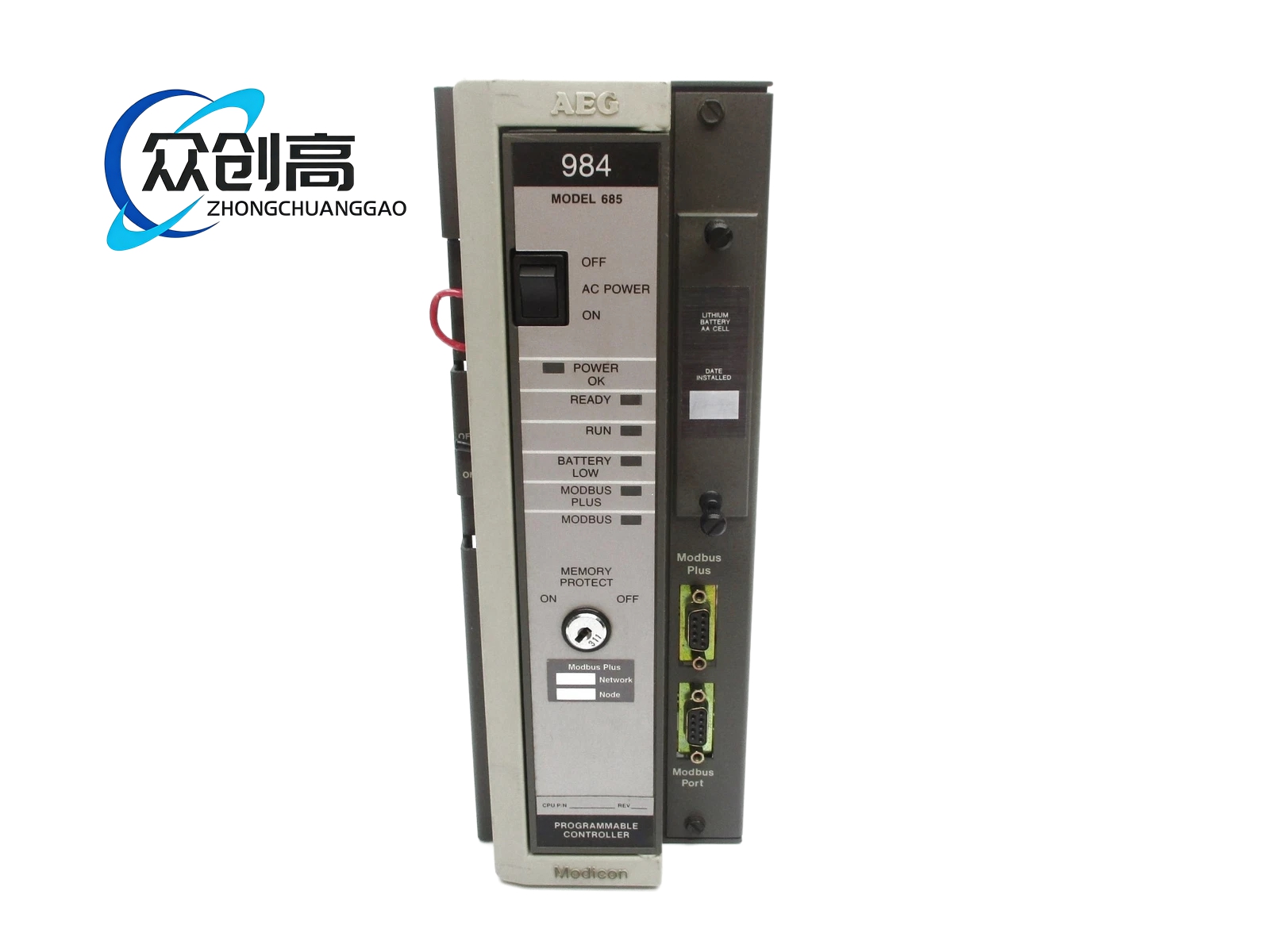
The AEG MM-PMC2-400 is a premium-class programmable motion controller from the Modicon PMC2 family, configured for 4-axis simultaneous coordinated motion control. It is engineered for the most demanding multi-axis applications including 4-axis CNC machining, complex robotics, multi-head packaging systems, and high-speed synchronized motion. Like all PMC2 controllers, it integrates full PLC functionality, motion control, and I/O management in a single compact unit.
Detailed content
Technical Specifications:
- Number of Axes: 4 servo/stepper axes (simultaneous interpolation)
- Interpolation Modes: Linear, Circular, 3D Circular, Helical, Point-to-Point, Polynomial
- Maximum Pulse Frequency: 4 MHz per axis (simultaneous on all 4 axes)
- Positioning Resolution: 32-bit (4,294,967,296 counts per revolution)
- Control Cycle Time: 1 ms (standard), 500 µs (high-speed mode), 250 µs (ultra-high-speed option)
- Program Memory: 2 MB Flash + 1 MB RAM
- I/O Capacity: Up to 512 digital I/O + 64 analog I/O (via expansion)
- Communication Ports: 2x Ethernet (10/100 Mbps), 1x RS-232, 1x RS-485, 1x CANopen, 1x USB (programming)
- Power Supply: 24V DC (nominal), 18V to 30V DC operating range
- Operating Temperature: 0°C to +55°C
- Storage Temperature: -20°C to +70°C
- Vibration Resistance: 5g (10–500 Hz) per IEC 60068-2-6
- Shock Resistance: 30g, 11 ms per IEC 60068-2-27
- Dimensions (W x H x D): 220 mm x 120 mm x 140 mm (approximate)
- Weight: Approximately 1.8 kg
Functional Features:
- 4-axis simultaneous interpolation with 256-block look-ahead
- Electronic cam (up to 32 cam tables)
- Electronic gear ratio (up to 16 gear tables)
- S-curve and trapezoidal acceleration profiles
- Jog, incremental, absolute, and continuous positioning modes
- Multi-reference home (index, limit switch, encoder Z, absolute encoder)
- IEC 61131-3 PLC programming: Ladder, FBD, SFC, ST, IL
- C-language macro programming for advanced motion algorithms
- FTP server, Web server, E-mail notification
- Data logging with timestamp (up to 10,000 records)
- PID control: up to 128 simultaneous loops
- Synchronized motion (cam following, flying shear, tandem axes)
Performance Parameters:
- Simultaneous Axes: 4 axes at full speed with continuous path control
- Maximum Contouring Speed: 150 m/min (dependent on axis tuning)
- Following Error Tolerance: 1 to 100,000 encoder counts (configurable)
- Servo Loop Update Rate: 1 kHz (1 ms), 2 kHz (500 µs), or 4 kHz (250 µs)
- Jerk Limitation: Fully configurable jerk control (3rd-order motion profile)
- Program Scan Time: < 0.3 ms for 2000 ladder rungs
- Interpolation Accuracy: ±0.5 encoder counts (at 1 ms cycle)
Material Composition:
- Housing: Aluminum alloy extrusion with black anodized finish (IP54 optional with gasket)
- PCB: 8-layer FR-4 with impedance-controlled differential pairs for encoder signals
- Connectors: Hirose DF40 series (encoders), Phoenix Contact (I/O), RJ45 (Ethernet)
- Display: 4.3″ color TFT LCD with touch panel (optional front panel)
- Enclosure Rating: IP20 standard, IP54 with optional sealed enclosure kit
Structural Features:
- Front panel with color LCD display and touch navigation
- 8 status LEDs: Power, Run, Fault, Axis 1–4 Active
- 4x high-speed differential encoder inputs (A+/A−, B+/B−, Z+/Z−)
- 2x RS-485 ports (servo drive communication)
- 2x Ethernet ports (programming + HMI/SCADA)
- USB port for program upload/download
- DIN rail or panel mount with M4 bracket holes
- Expansion bus connector for remote I/O
Working Principle:
The MM-PMC2-400 uses a dual-processor architecture: a high-speed DSP handles motion control at a fixed cycle (1 ms / 500 µs / 250 µs), while a separate RISC processor executes the PLC program and communication tasks. The motion engine computes trajectory setpoints for all 4 axes using real-time interpolation algorithms (linear, circular, 3D, polynomial). These setpoints are sent to servo drives via high-speed pulse outputs or analog commands. The look-ahead buffer (256 blocks) allows the controller to anticipate upcoming path changes, reducing following error and enabling smoother high-speed motion. The PLC processor and motion processor exchange data via dual-port RAM, ensuring tight synchronization between discrete logic and motion.
Advantages & Highlights:
- 4-Axis Simultaneous Motion: Full 4-axis interpolation with 256-block look-ahead
- Ultra-Fast Cycle: 250 µs option for highest-speed applications
- Integrated PLC + Motion: Eliminates need for separate PLC and motion controller
- Advanced Motion Features: Electronic cam, gearing, jerk control, synchronized axes
- Rich Connectivity: Dual Ethernet, CANopen, RS-485, USB, RS-232
- Color HMI: Built-in TFT display for local operation and diagnostics
Applicable Industries:
- 4-axis CNC milling and machining centers
- Laser cutting (4-axis beam positioning)
- Robot arm control (4-DOF articulated robots)
- Multi-head packaging and labeling machines
- Flying shear and cut-to-length with 4-axis synchronization
- Glass edge processing
- Semiconductor wafer handling
Installation Requirements:
- Mount on DIN rail (TS 35) or flat panel with M4 holes
- Connect encoder cables: shielded twisted-pair, differential RS-422, max 15 m (100 m with line driver)
- Connect servo drives via dedicated high-speed pulse cables (max 10 m recommended)
- Provide 24V DC power supply: minimum 8A capacity
- Ethernet cables: CAT5e or CAT6 shielded, max 100 m per segment
- Install in cabinet with ambient temperature below 55°C
Usage Precautions:
- Always perform 4-axis autotuning before running production programs
- Use shielded cables for all encoder signals — do not mix with power cables
- Do not exceed 4 simultaneous axes in interpolation mode
- Back up all programs and parameters before firmware updates
- Ensure adequate ventilation — internal temperature must not exceed 70°C